China Conducts Largest-Ever Live-Fire Military Drills Around Taiwan
Daniel Okoye
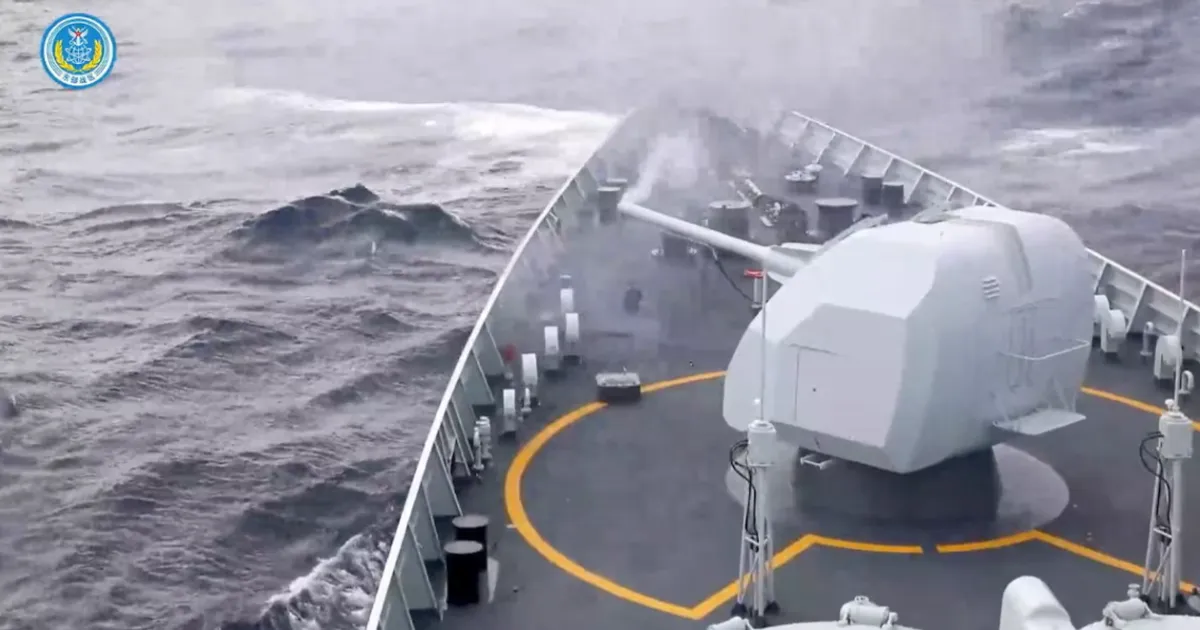
TAIPEI / BEIJING | Dec 30 (GeokHub) China on Tuesday launched extensive live-fire military exercises around Taiwan, marking the most expansive and closely positioned war games Beijing has ever carried out near the self-governed island.
According to China’s Eastern Theatre Command, naval and air force units conducted coordinated live-firing operations for roughly 10 hours across multiple zones surrounding Taiwan, targeting maritime, aerial and sub-surface threats. The drills extended until early evening and included anti-submarine warfare, strike simulations and amphibious assault operations in waters to Taiwan’s north and south.
Taiwanese officials said the scale and intensity of the exercises suggest Beijing is rehearsing a potential blockade scenario rather than routine military signalling.
UNPRECEDENTED SCALE AND NEW HARDWARE
The drills, officially named “Justice Mission 2025,” began less than two weeks after Washington announced a record arms sale to Taiwan, a move that Beijing has sharply criticised.
For the first time, China deployed its Type 075 amphibious assault ship during exercises around Taiwan, alongside bomber aircraft, destroyers and coast guard vessels. Chinese military analysts said the ship is capable of launching helicopters, landing craft, armoured vehicles and amphibious tanks simultaneously — significantly enhancing China’s capacity for large-scale landing operations.
Taiwan’s defence ministry reported that in the 24 hours leading up to Tuesday morning, 130 Chinese aircraft and 22 naval and coast guard vessels were detected operating around the island. Ninety of those aircraft crossed the unofficial median line of the Taiwan Strait, an act Taipei views as highly provocative.
TAIWAN MONITORS MISSILE ACTIVITY
A senior Taiwanese security official said authorities are closely watching whether Beijing escalates further by firing missiles over the island, a move China last made during drills in 2022 following a visit by a senior U.S. official.

The official added that the exercises appear designed to simulate strikes on land-based systems, including advanced rocket artillery supplied to Taiwan by the United States.
Five of the seven live-fire zones declared by China overlap with Taiwan’s claimed territorial waters, the defence ministry said, adding that frontline troops have been authorised to respond if Chinese forces breach defined limits.
IMPACT ON TRADE AND CIVIL AVIATION
The military activity has disrupted key transport routes in one of the world’s most important commercial corridors. Taiwan’s aviation authority said more than 100,000 passengers could be affected as most flight paths around the island were temporarily closed, leaving only a narrow northeastern route open for civilian traffic.
Roughly $2.4 trillion in global trade transits the Taiwan Strait annually, making any prolonged disruption a major concern for international markets.
ESCALATING RHETORIC AND PROPAGANDA
Chinese state media amplified the drills with aggressive messaging, releasing posters and AI-generated videos depicting advanced robotic weapons and simulated attacks on Taiwan. One widely circulated image portrayed Taiwan’s president under attack from symbolic “hammers of justice.”
Beijing’s rhetoric has intensified in recent weeks following comments from Japanese leaders suggesting Tokyo could respond militarily in the event of a conflict over Taiwan.
STRATEGIC TIMING AND LONG-TERM SIGNALS
Western defence officials view the drills as part of a broader strategy tied to China’s military modernisation goals. A recent U.S. defence assessment suggests Beijing aims to be capable of prevailing in a Taiwan conflict by 2027, a milestone year marking the People’s Liberation Army’s centenary.
While China has invested heavily in military expansion, recent anti-corruption purges within the armed forces and declining revenues among defence firms have raised questions about operational readiness.
Still, analysts say the scale of this week’s exercises sends a clear signal of Beijing’s intent to project power and pressure Taiwan at a moment of heightened regional tension.