U.S. Researchers Say Russia Likely Deploying Nuclear-Capable Missiles at Belarus Base

GeokHub
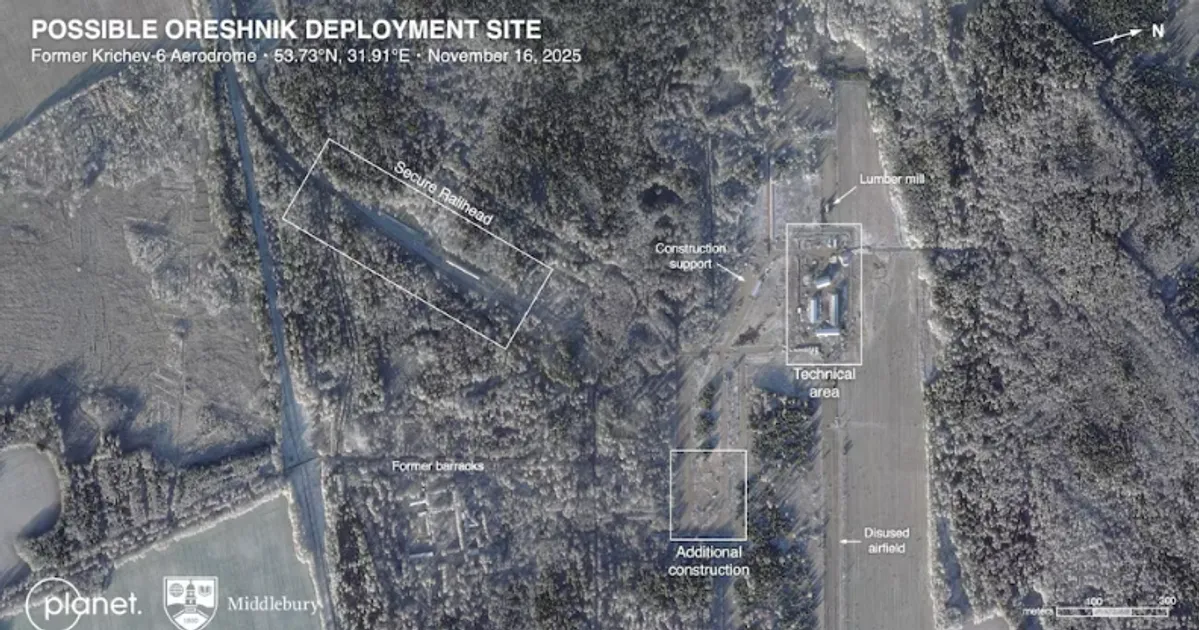
WASHINGTON, Dec 26 (GeokHub) Russia is likely positioning new nuclear-capable hypersonic ballistic missiles at a former airbase in eastern Belarus, a move that could significantly extend Moscow’s ability to strike targets across Europe, according to two U.S. researchers who analyzed recent satellite imagery.
The findings, based on commercial images from Planet Labs, broadly align with U.S. intelligence assessments, a person familiar with the matter told Reuters.
Russian President Vladimir Putin has previously said Moscow intends to deploy its intermediate-range Oreshnik missile system in Belarus, but the precise location had not been publicly identified until now. The researchers believe the missiles would be stationed near Krichev, roughly 190 miles east of Minsk and about 300 miles southwest of Moscow.
What Is the Oreshnik Missile?
The Oreshnik — Russian for “hazel tree” — is a nuclear-capable hypersonic ballistic missile with an estimated range of up to 5,500 km (3,400 miles). Russia tested a conventionally armed version of the missile against a target in Ukraine in November 2024.
Putin has claimed the weapon is impossible to intercept, citing reported speeds exceeding Mach 10.
Experts say deploying the missile in Belarus would allow Russia to project power deeper into Europe, while reinforcing nuclear deterrence messaging aimed at NATO countries supporting Ukraine.
Satellite Evidence Points to Missile Base
Researchers Jeffrey Lewis of the Middlebury Institute of International Studies and Decker Eveleth of the CNA research group said imagery showed construction consistent with a Russian strategic missile installation.
They said they are 90% confident that mobile Oreshnik launchers are intended for the site.
Among the indicators:
- A military-grade rail transfer point enclosed by fencing, suitable for transporting missiles and launchers by train.
- A newly poured concrete pad at the end of a runway, later covered with earth — consistent with a camouflaged launch position.
- Rapid construction activity beginning in early August, suggesting urgency.
The site appears capable of housing three launchers, though Belarusian President Alexander Lukashenko has said up to 10 Oreshnik missiles could eventually be deployed in the country, implying additional locations may exist.
Strategic and Political Implications
Analysts say the deployment underscores a shift in Russian nuclear posture, coming just weeks before the expiration of the 2010 New START treaty, the last remaining agreement limiting U.S. and Russian strategic nuclear weapons.
“This move is about extending Russia’s reach into Europe,” said John Foreman, a former British defense attaché in Moscow and Kyiv. He added the decision may also be a response to U.S. plans to deploy conventional hypersonic Dark Eagle missiles in Germany next year.
The Belarusian defence minister said the deployment would not alter Europe’s balance of power, calling it a response to what Minsk described as Western “aggressive actions.”
Skepticism From Some Experts
Not all analysts agree the move offers Russia tangible military advantages. Pavel Podvig, a Geneva-based nuclear weapons expert, said the deployment is unlikely to change Western calculations.
“I don’t see how this would be viewed as fundamentally different from deploying the missiles inside Russia,” he said.
Lewis disagreed, arguing the move is largely symbolic but politically powerful.
“There is no military reason to put the system in Belarus — only political ones,” he said, comparing it to the hypothetical deployment of nuclear-armed U.S. missiles in Germany.
Broader Context
The reported deployment comes as U.S. President Donald Trump seeks a negotiated end to the war in Ukraine. Kyiv has pressed Western allies for longer-range weapons, while Washington has so far declined to provide Tomahawk cruise missiles.
Britain and France have supplied cruise missiles, and Germany has announced plans to co-produce long-range missiles with Ukraine without range restrictions.