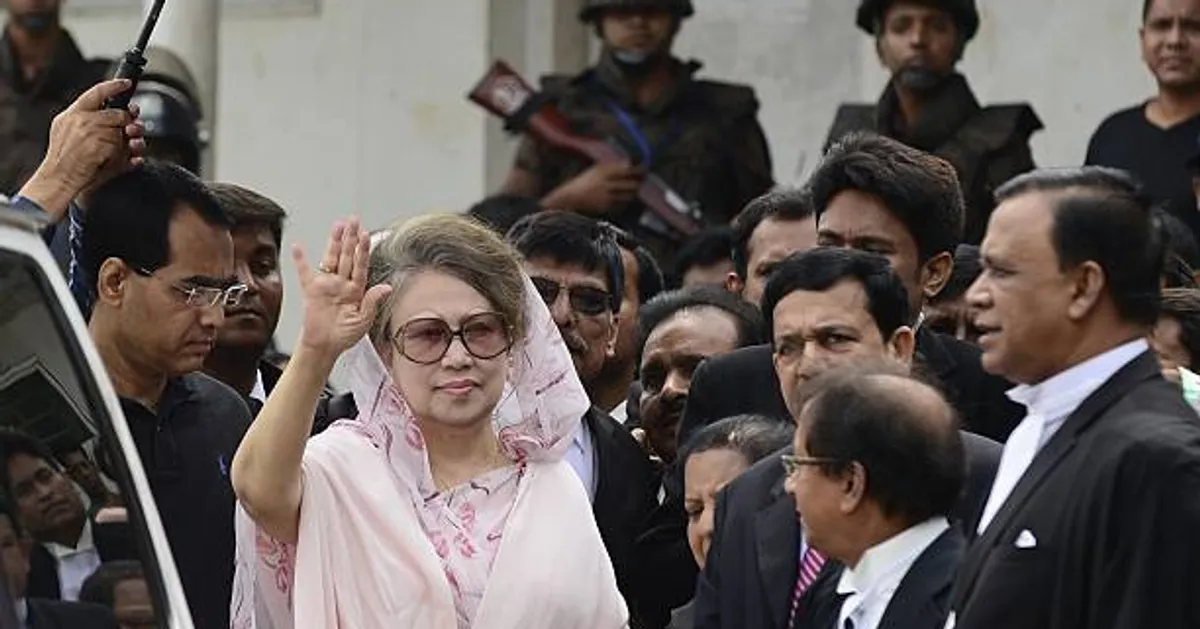
DHAKA | Dec 30 (GeokHub) Khaleda Zia, the first woman to serve as prime minister of Bangladesh and one of the most influential — and divisive — figures in the country’s modern political history, has died at the age of 80 after a prolonged illness, her party said on Tuesday.
The Bangladesh Nationalist Party (BNP), which she led for decades, said Zia passed away following years of declining health. Doctors had previously confirmed she suffered from advanced liver disease, diabetes, arthritis and heart-related complications. She had traveled to London earlier this year for extended medical treatment before returning home.
Though absent from office since 2006 and periodically confined to prison or house arrest, Zia remained a commanding presence in Bangladeshi politics, retaining strong grassroots loyalty across large sections of the country.
Her death comes at a pivotal moment. Bangladesh is scheduled to hold parliamentary elections in February, with the BNP widely viewed as the leading contender. Her son, Tarique Rahman, who serves as acting party chairman, returned to Bangladesh last week after nearly 17 years abroad and is seen as a potential prime ministerial candidate.
FROM PRIVATE LIFE TO POLITICAL LEADERSHIP
Known simply as Khaleda, she lived a largely private life until tragedy pushed her into the political arena. Her husband, Ziaur Rahman, a former army chief and president who founded the BNP, was assassinated during a failed military coup in 1981.
Three years later, Khaleda assumed leadership of the party, pledging to advance her late husband’s vision of economic reform and national development. Initially reserved in public, she soon emerged as a formidable political figure.
In 1990, she joined forces with Sheikh Hasina, daughter of Bangladesh’s founding leader, to lead a mass movement that ended military rule. Their alliance, however, quickly collapsed into one of South Asia’s most enduring political rivalries.
THE ‘BATTLING BEGUMS’ ERA
The rivalry between Khaleda Zia and Sheikh Hasina — often dubbed the “Battling Begums” — defined Bangladesh’s politics for more than three decades. Their contrasting styles and personalities fueled repeated electoral showdowns, street protests and political unrest.
In 1991, Bangladesh held its first widely accepted democratic election. Khaleda secured a surprise victory, becoming the country’s first female prime minister and only the second woman to lead a Muslim-majority democracy, after Pakistan’s Benazir Bhutto.
During her first term, she restored the parliamentary system, encouraged foreign investment and made primary education free and compulsory. She lost power in 1996 but staged a dramatic comeback five years later with a landslide win.
CONTROVERSIES AND DECLINE
Her second term was overshadowed by rising Islamist militancy, corruption allegations and worsening political violence. A deadly grenade attack on an opposition rally in 2004 — which Sheikh Hasina survived — left lasting scars on the nation’s politics and deepened mistrust between the two camps.
In 2006, amid growing instability, an army-backed interim administration took charge, arresting both Khaleda and Hasina on corruption-related charges. Though released ahead of the 2008 election, Khaleda never returned to office.
Her party later boycotted multiple elections, while legal cases led to her imprisonment in 2018. She was transferred to house arrest in 2020 as her health deteriorated and was fully released in 2024 following Hasina’s removal amid mass protests.
Earlier this year, Bangladesh’s Supreme Court overturned corruption convictions against both Khaleda and her son, clearing legal obstacles that had sidelined the family for years.
A POLARISING LEGACY
To supporters, Khaleda Zia was dignified, measured and resolute — a leader who defended democratic pluralism. To critics, her tenure symbolized missed opportunities and political brinkmanship.
Her decades-long feud with Hasina often paralyzed governance, contributing to cycles of unrest that slowed development in a nation of more than 170 million people vulnerable to poverty and climate disasters.
Yet few dispute her historic role in shaping modern Bangladesh. With her passing, an era dominated by two towering figures appears to be drawing to a close.