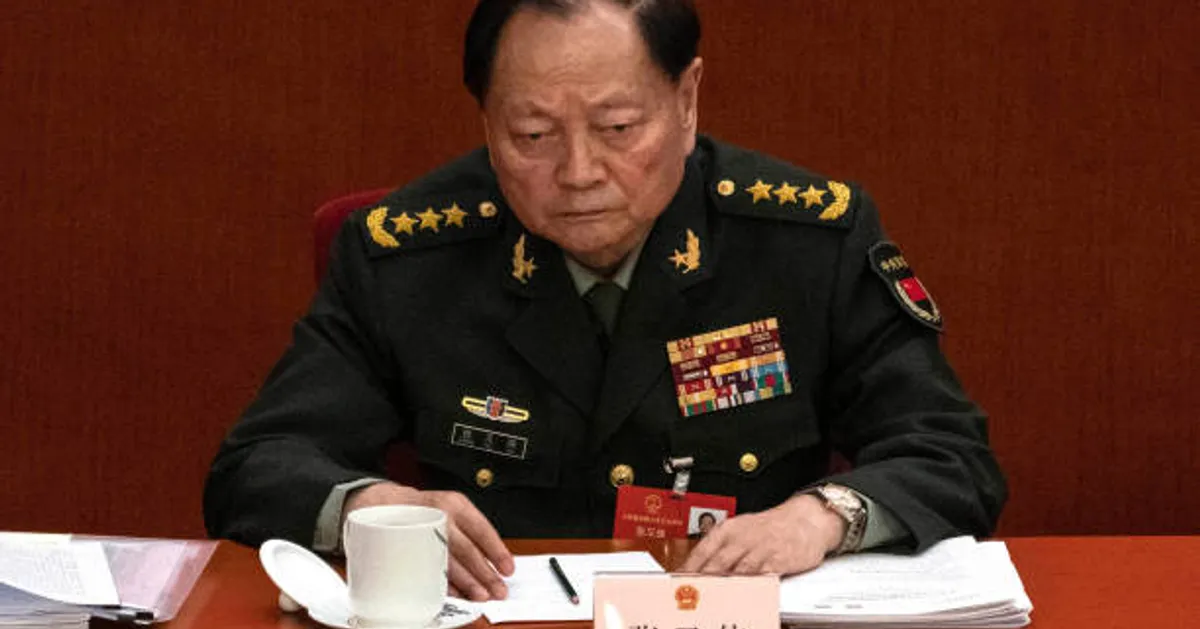
BEIJING / WASHINGTON | Jan 26 (GeokHub) China’s sweeping anti-corruption campaign has moved decisively into President Xi Jinping’s closest political and military circle, as authorities launch an investigation into a senior general long regarded as one of his most trusted allies.
The probe into General Zhang Youxia, a veteran military leader and senior member of China’s top armed forces command, signals a sharp escalation in Xi’s years-long purge and underscores a central message: personal ties offer no immunity when party loyalty is questioned.
Analysts say the move further consolidates power in Xi’s hands, deepens opacity around China’s military leadership, and suggests Beijing is unlikely to pursue a major military confrontation — including over Taiwan — in the near term.
A Rare and Symbolic Break with the Past
Zhang, 75, has long been viewed as part of Xi’s inner circle. Both men are so-called “princelings,” the children of former senior Communist Party officials. Despite expectations that Zhang would retire in 2022, Xi extended his tenure on the Central Military Commission (CMC), China’s highest military decision-making body — a sign of their closeness.
That backdrop makes the investigation especially striking.
“This marks a profound shift,” said one China analyst, noting that earlier purges typically targeted officials with weaker personal ties to Xi. “This time, the crackdown has reached the very core of the system.”
China’s defence authorities said Zhang is being investigated for “serious violations of discipline and law,” a formulation commonly used in corruption cases. No further details were provided.
Power Concentration and a Thinner Command Structure
Zhang’s investigation comes alongside scrutiny of another senior officer, effectively reducing the once seven-member Central Military Commission to just a handful of active leaders, with Xi firmly at the top.
Experts say the move reinforces Xi’s authority over the armed forces but also leaves China’s military leadership unusually depleted.
“It’s not entirely clear how command and decision-making are functioning right now,” one security analyst said, noting that many potential successors have already been removed in previous rounds of the purge.
State military media described the investigation as a major achievement in enforcing the system that places ultimate authority in the hands of the Communist Party chairman — a role held by Xi himself.
Corruption, Control, and Political Signaling
The military has been a major focus of Xi’s anti-corruption drive since he took power in 2012. In recent years, the campaign has ensnared senior figures across China’s defence establishment, including former defence ministers and top officials linked to weapons procurement and missile forces.
While corruption concerns are widely believed to be genuine, analysts say such charges often double as a political tool in elite power struggles.
By moving against Zhang, Xi may also be countering criticism that his campaign has spared allies while targeting rivals.
“This sends a message that no one gets a free pass,” said a regional security expert. “It strengthens Xi’s image as the ultimate arbiter of loyalty.”
Implications for Taiwan and Regional Security
The shake-up could have near-term consequences for China’s military readiness. Analysts expect some high-level initiatives, such as expanded joint training and structural reforms, to slow until leadership vacancies are filled.
At the same time, the purge may indicate caution rather than urgency in Beijing’s military planning.
“Removing so much of the top command suggests Xi is not preparing for a major escalation in the immediate future,” said one analyst. “Instead, he appears focused on reshaping the military leadership to ensure long-term loyalty and competence.”
China has stepped up military pressure around Taiwan in recent years, including large-scale drills, but experts say Xi has time to consolidate control, particularly with Taiwan’s next election still years away.
A Mission to Reshape the Military
Observers believe Xi may wait until the next Communist Party Congress to appoint a new generation of military leaders after extensive vetting.
Until then, the armed forces are expected to continue advancing Xi’s long-term modernization goals, even as internal restructuring continues.
“Xi is determined to ensure the military answers to the party — and to him — above all else,” one analyst said. “He is prepared to take extraordinary steps to achieve that.”