PALM BEACH, Florida / WASHINGTON, Jan 3 (GeokHub) — President Donald Trump’s decision to launch a military operation against Venezuela, detain its president and declare that the United States will temporarily run the country represents one of the most dramatic departures yet from his long-standing pledge to avoid foreign entanglements.
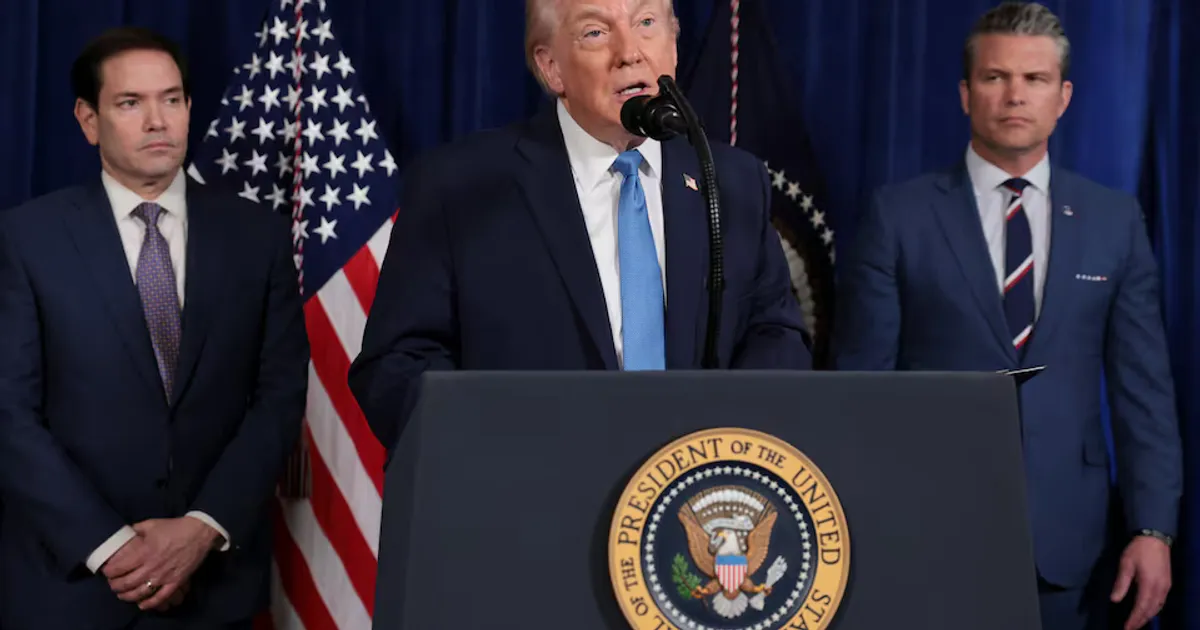
Speaking at a midday news conference, Trump said Washington would oversee Venezuela until a “safe, proper and judicious transition” could be arranged, raising the prospect of prolonged U.S. involvement in the country’s politics, security and oil industry. He did not clarify how long U.S. forces might remain or how far the intervention could extend.
“We are going to run the country until such time as we can do a safe, proper, and judicious transition,” Trump said.
The comments came hours after U.S. forces struck targets in Caracas and other areas and captured Venezuelan President Nicolás Maduro and his wife, who are expected to face drug-trafficking charges in New York. Senior figures from Maduro’s inner circle appeared to remain in control inside Venezuela.
Break With MAGA Orthodoxy
Trump’s actions contrast sharply with rhetoric he used at the start of his second term, when he promised to measure success by “the wars we never get into.” That message resonated with voters drawn to his criticism of past U.S. military interventions.
Since returning to office, however, Trump has ordered strikes across multiple regions, including the Middle East, Africa and the Caribbean, and authorized operations against alleged drug-trafficking networks at sea. The Venezuela operation marks his most sweeping military action to date.
Some Republicans who had hoped Trump would focus on domestic priorities such as inflation, healthcare and economic growth expressed unease. Trump defended the move as consistent with his “America First” policy, arguing that stability in Venezuela — home to vast oil reserves — is vital to U.S. interests.
“We want good neighbors. We want stability. We want energy,” he said.
The political tension inside Trump’s own coalition was underscored by a public break from Representative Marjorie Taylor Greene, a vocal supporter of the MAGA movement, who said the intervention contradicted what many voters believed they were supporting. She is set to leave Congress next week.
Political and Electoral Risks
Democrats quickly seized on the intervention as evidence of reckless leadership ahead of November’s midterm elections, when control of Congress is expected to hinge on a narrow margin.
“Launching military action without congressional authorization and without a clear plan for what comes next is reckless,” Senate Minority Leader Chuck Schumer said.
While Trump has sought diplomatic credit for efforts to wind down conflicts elsewhere, military interventions historically carry higher political risk. Public opinion surveys conducted before the operation showed limited support for using force to remove Maduro.
Republican Divisions
The intervention has also reignited a long-running debate within the Republican Party over executive war powers. Some lawmakers initially questioned whether Trump had the authority to act without congressional approval.
Others said briefings from senior administration officials persuaded them the operation fell within presidential powers, though critics noted apparent inconsistencies between the administration’s claim of a law-enforcement mission and Trump’s broader statements about governing Venezuela.
Echoes of Past Interventions
Trump has long criticized Republican “neoconservatives,” yet analysts note parallels between the Venezuela operation and past U.S. interventions in Latin America, including the invasions of Grenada in 1983 and Panama in 1989, both justified at the time by claims of illegitimate leadership and security threats.
Former U.S. officials sympathetic to Trump argued the removal of Maduro carries limited political risk as long as American casualties remain low, but acknowledged uncertainty over what “running Venezuela” would entail.
Foreign policy analysts warned the United States could become deeply involved in managing Venezuela’s political transition and regional fallout.
“I don’t see a quick exit here,” said Brett Bruen, a former U.S. foreign policy adviser. “The United States is likely to get entangled in Venezuela and face new challenges with its neighbors.”