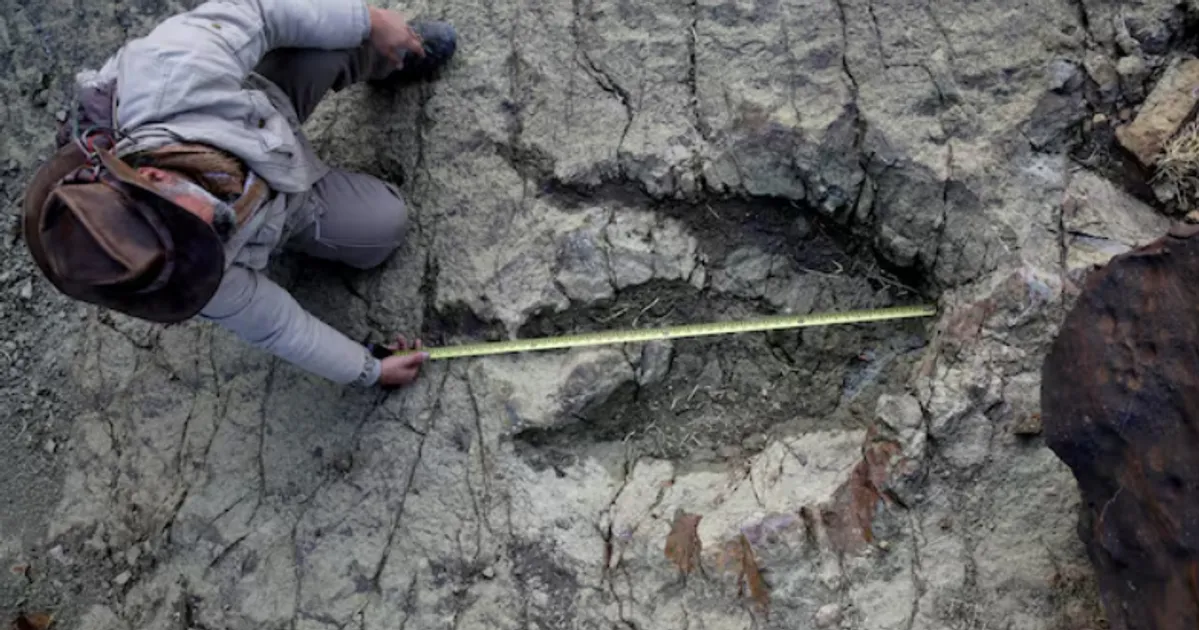
WASHINGTON, Feb 6 (GeokHub) — Dinosaur footprints are among the most frequently discovered fossils, ranging from isolated impressions to dense networks of tracks that resemble a prehistoric dance floor. Yet for decades, scientists have struggled with a basic question: which dinosaur made which footprint?
Researchers have now introduced an artificial intelligence–based approach designed to help solve that mystery. The new method analyzes eight distinct characteristics of fossilized footprints to better determine the type of dinosaur that left them behind.
“This matters because it gives us a more objective way to compare and classify tracks, instead of relying mostly on human judgment,” said Gregor Hartmann, a physicist at Germany’s Helmholtz-Zentrum Berlin and lead author of the study published in Proceedings of the National Academy of Sciences.
Linking a footprint to its maker has long been a contentious issue in paleontology. “Scientists have debated this for generations,” said Steve Brusatte, a paleontologist at the University of Edinburgh and senior author of the research.
While dinosaurs left behind many kinds of fossils — including bones, teeth, skin impressions, eggshells, and even fossilized waste — footprints are often the most abundant. They can reveal valuable information about ancient environments and show which species shared the same ecosystems.
To develop the new tool, researchers trained an algorithm on 1,974 footprint outlines spanning roughly 150 million years of dinosaur history. The AI identified eight features that explain most of the variation in track shapes. These include overall footprint shape and pressure distribution, toe spread, how toes connect to the foot, heel placement and loading, the balance between toe and heel pressure, and asymmetry between the left and right sides of a track.
Many of the analyzed footprints had already been confidently linked to specific dinosaur groups by experts. Once the algorithm highlighted the most important distinguishing traits, scientists mapped those features to known dinosaur types, creating a framework that could help identify newly discovered tracks.
Still, uncertainty remains unavoidable. “Footprints are influenced by far more than just the animal’s anatomy,” Hartmann explained. Factors such as movement speed, behavior, ground conditions, moisture, burial by sediment, and millions of years of erosion can all dramatically alter a track’s appearance. As a result, the same dinosaur can leave very different footprints.
Size adds another layer of complexity. “Footprints range from those no bigger than chicken tracks to massive impressions the size of a bathtub,” Brusatte said, referring to the contrast between small meat-eating dinosaurs and giant sauropods.
Finding a skeleton directly associated with a trackway is extremely rare. Brusatte noted he could recall only one such example. “So most of the time, we have to play detective,” he said, comparing the process to matching Cinderella’s foot to the glass slipper.
One of the study’s most intriguing findings involved seven small, three-toed footprints from South Africa that are about 210 million years old. The AI confirmed earlier assessments that these tracks closely resemble those of birds — despite being around 60 million years older than the earliest known bird fossils. Birds are known to have evolved from small, feathered, two-legged dinosaurs.
“This doesn’t mean birds made the tracks,” Brusatte cautioned. They could have been left by unknown dinosaur species closely related to birds, or by unrelated dinosaurs that happened to have bird-like feet. “But it’s a signal we need to take seriously and investigate further.”